An international hub can remain efficient only if transfers are viewed as an integrated spatial and operational system.
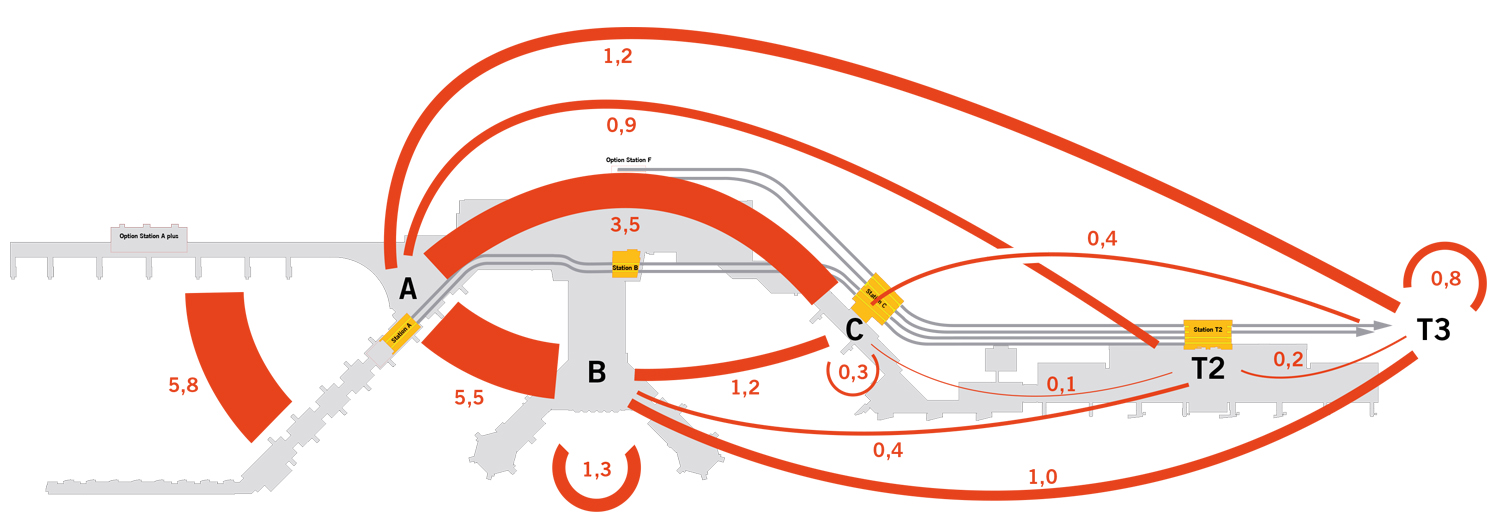
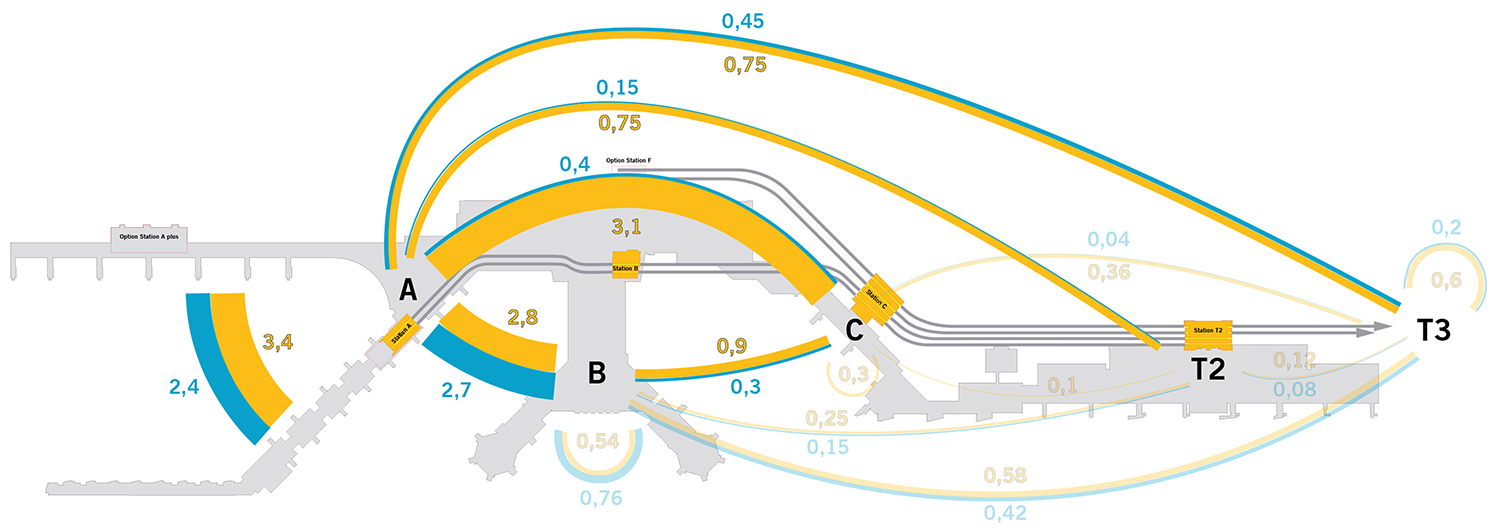
At Frankfurt Airport, just a few minutes can make or break the quality of a transfer-and thus the efficiency of the entire hub. Rising demand for capacity, terminal expansions, and changes in usage patterns are shifting passenger flows and placing greater demands on routes, processes, and modes of transportation. The task therefore directly links spatial planning with strategic operational organization. For ASTOC, the relevance lies in this interface. Airports are highly dense systems in which architecture, mobility, security, and process times are directly interdependent. Improvements arise from the interplay of wayfinding, orientation, control, comfort, and transportation. The study thus complements the firm’s focus on airport planning by incorporating the dimension of passenger flows and their spatial implications.
Functional Analysis of Infrastructure to Improve Interchange Efficiency
Functional Analysis of Infrastructure to Improve Interchange Efficiency
The different terminal structures have a direct impact on the spatial possibilities. The centralized security concept of Terminal 1 facilitates the integration of controlled connections via passenger transport systems (PTS). At the time of planning, Terminal 2 requires more complex interventions due to its decentralized security organization. This highlights how closely passenger flow, security protocols, and the building’s structure are intertwined. The planning horizon itself becomes a key design factor.
Passenger-Transport-Systems (PTS) between Terminals 1 through 3
The existing PTS handles both airside transfer traffic and landside connections between terminals. As the airport expands, these two functions will give rise to different requirements. In the long term, therefore, the hub needs a clear separation between rapid transfer transportation and landside terminal distribution. Optimizing transfer services involves travel time, process flows, security checks, wayfinding, comfort, and the overall passenger experience. Improvements at these touchpoints directly impact the minimum connecting time and the quality of the hub. Spatial planning thus becomes a tool that simultaneously influences operational efficiency and the passenger experience.
Frankfurt demonstrates that an airport’s efficiency also depends on the architecture of its traffic flows. A resilient transfer system combines short-term interventions with a long-term systemic approach. Especially in growing hubs, spatial quality emerges where mobility, operations, and wayfinding are conceived as a unified network.