
Integrated Redevelopment and Land-Use Strategies
It is becoming increasingly clear that the future of our cities and their neighborhoods will no longer be created primarily through new construction, but through the intelligent use of what is already there. Integrated refurbishment and usage strategies that take existing buildings seriously and recognize and utilize their potential receive ever more attention. Urgent questions arise regarding existing refurbishment requirements, possibilities for subsequent use and the efficient, long-term utilization of existing structures. And not just for buildings, but for entire areas and neighborhoods. At the same time, funds are becoming scarcer and investment pressure is increasing. In many neighborhoods, for example, the necessary renovation budgets have long exceeded the available funds. This gives rise to new key planning questions: What strategies are needed for entire areas? What priorities need to be set? What synergies can be exploited? Which implementation steps are possible and how quickly?
Practical examples point the way. Plans for areas at the University of Cologne, for example, are already moving in the direction of consolidation and densification rather than expansion. Across Germany, neighborhoods and housing estates are being comprehensively renovated, and not only the buildings are being considered, but also the open spaces and mobility. Positive “side effects” of structural refurbishment are increasingly turning into central goals: improved climate resilience of neighborhoods, new mobility options, technical security of supply, communal use of open spaces and a focus on neighborly interaction. This development has an impact from the property to the neighborhood and vice versa. Take the Eickhof neighbourhood in Hattingen, for example, which has not only upgraded its buildings in terms of construction and energy efficiency and embedded them in usable green spaces, but also considers social aspects as a central component: the preservation of the tenants and the realization of a daycare centre and a dementia flat-sharing community. Or the former Daimler housing estate in Stuttgart, which focuses on an appropriate densification of the existing neighborhood with different types of housing, whilst simultaneously upgrading the public space and the neighborhood address.
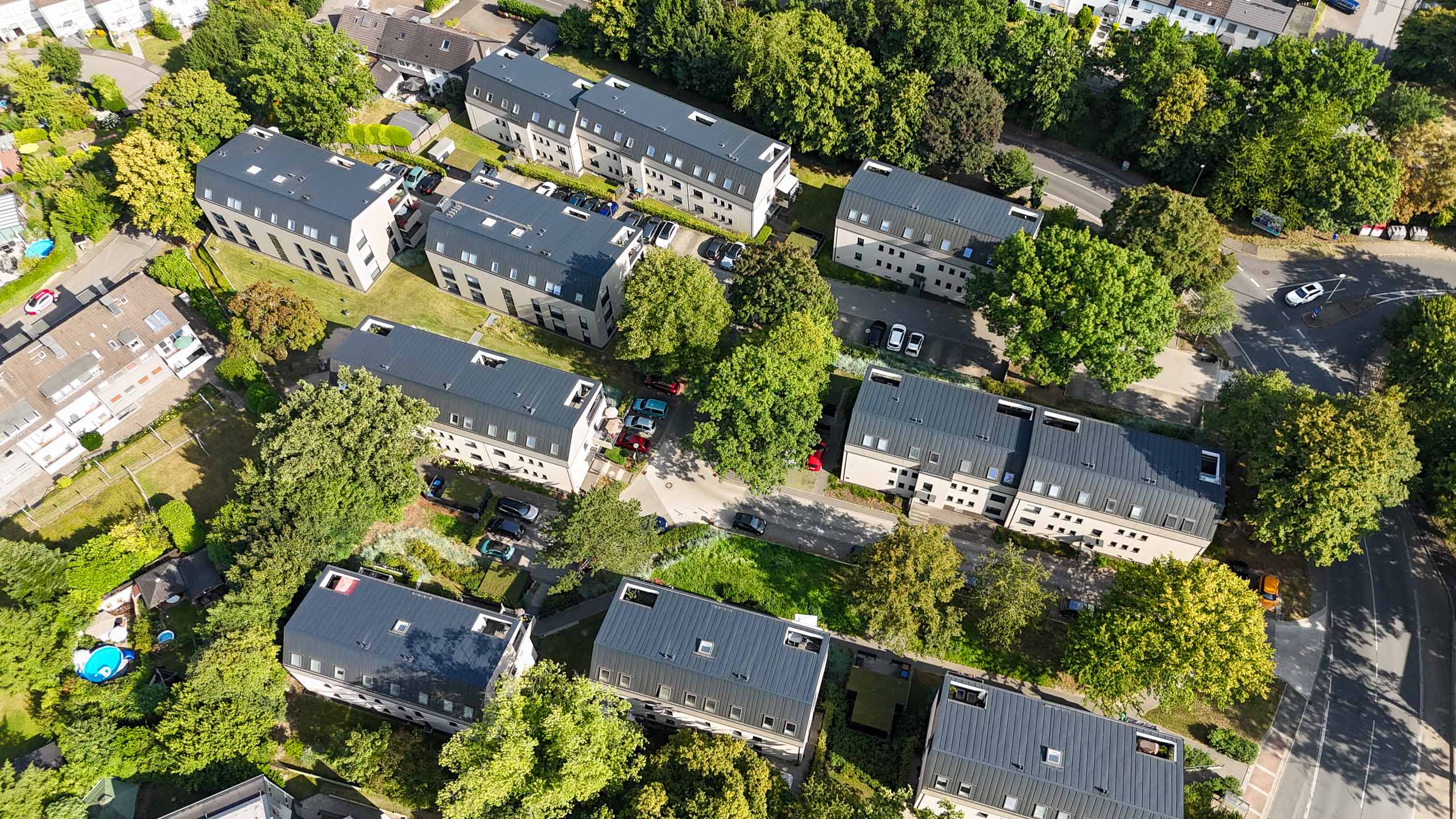

The future of cities is therefore created where they learn to work productively with their own existing buildings. Where refurbishment is not understood as repair, but as further development and a planning approach. Where every scale level – from the entire area to the individual building – is thought of in an interlinked way so that surprising added value can be created. And where limited resources do not result in less quality, but more clarity about goals, priorities and implementation options. In short, where stability and progress are not opposites, but enable each other.
Credit: Jens Willebrand, ASTOC